


 Email
Email Print
Print Feed
FeedFashion Finds in Alaska Reinvent the Traditional
An Athabascan designer's fish-skin garments push fashion forward in Alaska. Plus a mask carver designs fashion-statement pieces and another artist creates sealskin slippers, jackets and skirts.

A model sports shoe and shirt created by designer Joel Isaak (Athabascan).
Courtesy of Joel Isaak
(page 1 of 2)
Before Joel Isaak (Athabascan) learned to sew fish skin at an Anchorage Museum workshop, he grew up skinning the scaly creatures beginning at age 5. Usually the fish skin went to the dogs.
Over time, Isaak realized the beauty of the fish scales, however, and felt they could be of better use. “What can I make out of it?” he recalls wondering back then.
It’s all too evident now.
Fish-skin sewing, a traditional art form, survives through exquisite garments like the ones Isaak makes, and it pushes Alaskan Native fashion forward. A jacket from a recent collection, for example, is made of halibut skin, which—like other fish dermis—makes for a thin leather-like material, the artist says. And upon close inspection, it’s clear that high heels show off salmon scales.
“It’s such an abundant material,” says the Alfred University graduate student, who is 25. “I did not want to take it for granted.”
Working with fish skin is a craft that may have been on the brink of being lost, until something of a small revival emerged in recent years.
Even now, there may be fewer than 10 people in Alaska who know how to work with fish skin. That’s according to Trina Landlord, executive director of the Anchorage-based Alaska Native Arts Foundation. She says most artists who have taken up the art form, like Isaak, are self-taught.
“It was on the verge of extinction,” he says. “It’s coming back now from almost being lost.”
Throughout the past year, Isaak has kept the art alive through workshops. “It’s a really intergenerational learning [environment]—old, young, college-aged. The youth are really excited about doing it,” he says.
Commercial industries for readily available fish skin exist around the world, but they do not exist in Alaska. Instead of having the luxury to buy the material from the store, Isaak gets the raw skin by catching the fish himself.
From skinning to tanning, preparing one fish for garment-making can take anywhere from 10 to 15 hours. The process includes removing the fat and meat, washing the skin well enough to get rid of the oils, drying it to a point where it does not smell like fish, and, if needed, tanning the skin.
“With all the steps you have to do with dealing with the skin, it adds up,” says Isaak, who is well known for his work among Alaskan Native fashionistas, as he’s shown his work on local runways during community events and given workshops. “When I’m doing a lot at a time, it takes about 10 hours because it becomes more efficient.”
Although Isaak learned how to sew at a young age from his grandmother, it took a collective nine months to research the craft of fish-skin sewing.
Watertight and waterproof stitches—that’s the lost art component of fish-skin sewing, Isaak says.
“I strove to work with others and understand the cultural significance of fish and learn about the traditional forms of fish-skin making for all kinds of stuff,” he says. “I think as a collective Native populace, if we want to keep our materials alive, we need to maintain historical information of the material.”
After teaching himself to sew the tough skin, Isaak interviewed an elder and sewed fish skin in front of her to make sure he was doing it right. It turns out he was.
Many elders still alive know the craft but do not do it anymore. You just have to find them, he says. Only a handful of professional artists work with fish skin.
Both men and women want to sew. In previous generations, men did not spend much time sewing, but they were competent at it. For example, if their boot tore while they were out hunting, they had to know how to repair it, Isaak says.
The 15 to 60 participants in Isaak’s workshops create a wide range of accessories from the fish skin, such as wallets, purses and gloves. The skin is used more as a “decorative asset” to make the accessory pop, Isaak says.
Surprisingly enough, fish-skin sewing is like sewing leather. The material is “not delicate,” but “pretty strong,” Isaak says. One can sew fish skin with a sewing machine or hand-stitch it.
At the 2013 Clare to Clare Fashion Show in Anchorage, 10 designers created wearable art for the “Water Collection,” showcasing their vision of water. For the show, Isaak created a unique line of garments including a halibut-skin jacket, an ombré (graduated shades of color) couture salmon-skin dress, a corset, heels and a vest. His pieces also were shown at the “Wear Art, Thou?” fashion show, part of the Alaska Native Visionary Awards, held in November 2013.
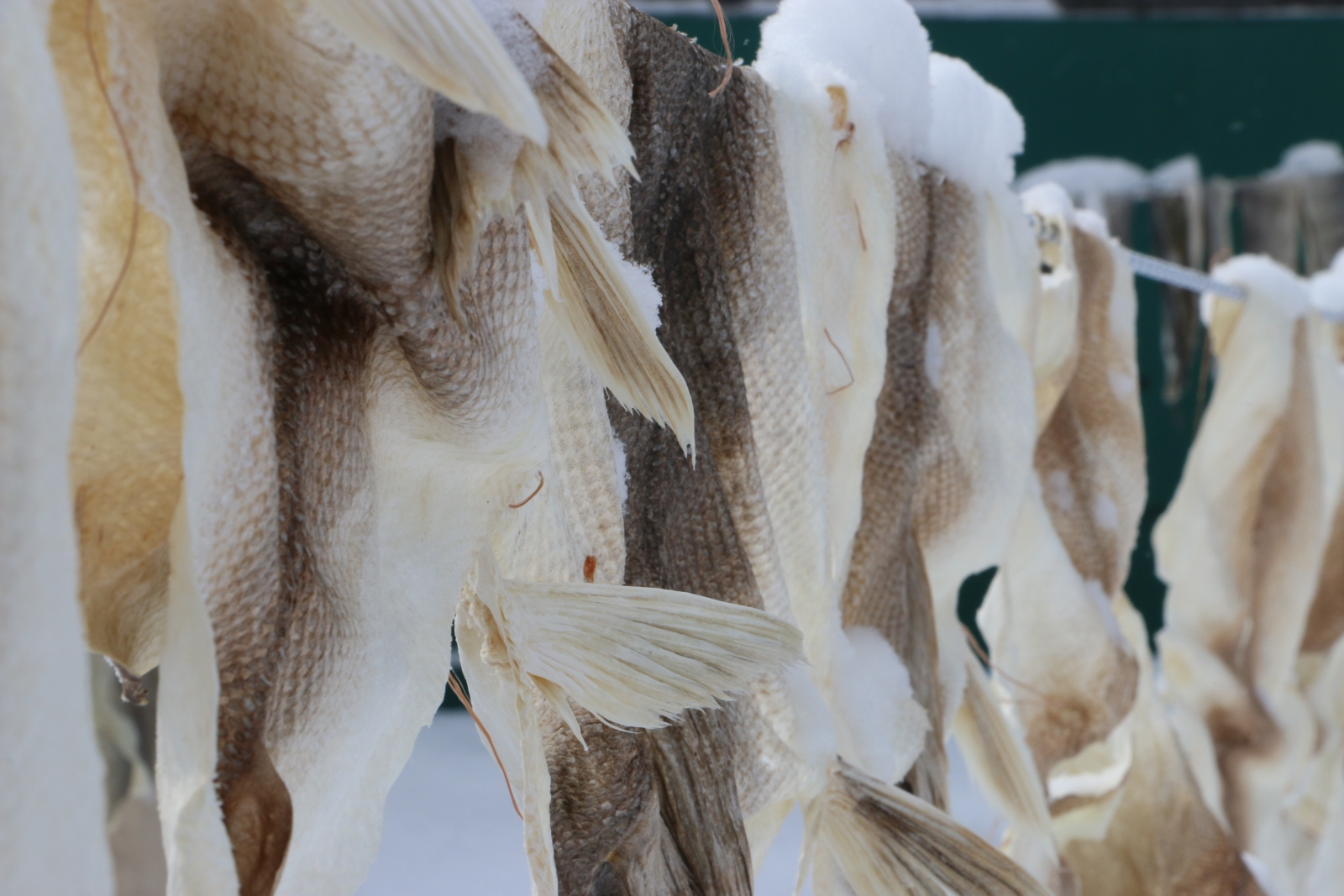
Sewing a fish-skin garment requires long hours, staring with washing the skin well enough to get rid of the oils. Above, fish skin is dried for garments created by Isaak. (Photo courtesy of the artist).
....
Though these garments were specifically made for a fashion show, Isaak says they can function as everyday wear. He wears the vest to formal events when he wants to be in Native regalia, and the halibut jacket functions well on chilly days.
As for the ombré salmon-skin dress, it is more like a “couture concept” and would be very warm to wear, since the material feels like thin leather, he says.
Couture in the nation’s most northern state is an exciting concept, given that fashion seemed nonexistent growing up in Anchorage, Landlord says. Everything would be utilitarian in nature, whereas now people are modernizing traditional designs and the functionality remains intact.
“I think it’s really empowering to come from a place not having a venue or platform to showcase Native fashion, then taking initiative and being proactive and saying, ‘Hey, we are here as Native people and are finding our place on the runway.’ I think it’s really cutting-edge,” Landlord says.
Jourdan Bennett-Begaye (Diné) is a recent graduate of Fort Lewis College in Durango, Colorado. She interned for the Farmington (New Mexico) Daily Times as part of the American Indian Journalism Institute, and she is currently a fellow of the Native American Journalism Fellowship, a partnership of the Native American Journalists Association, Newseum Institute and University of Montana.


